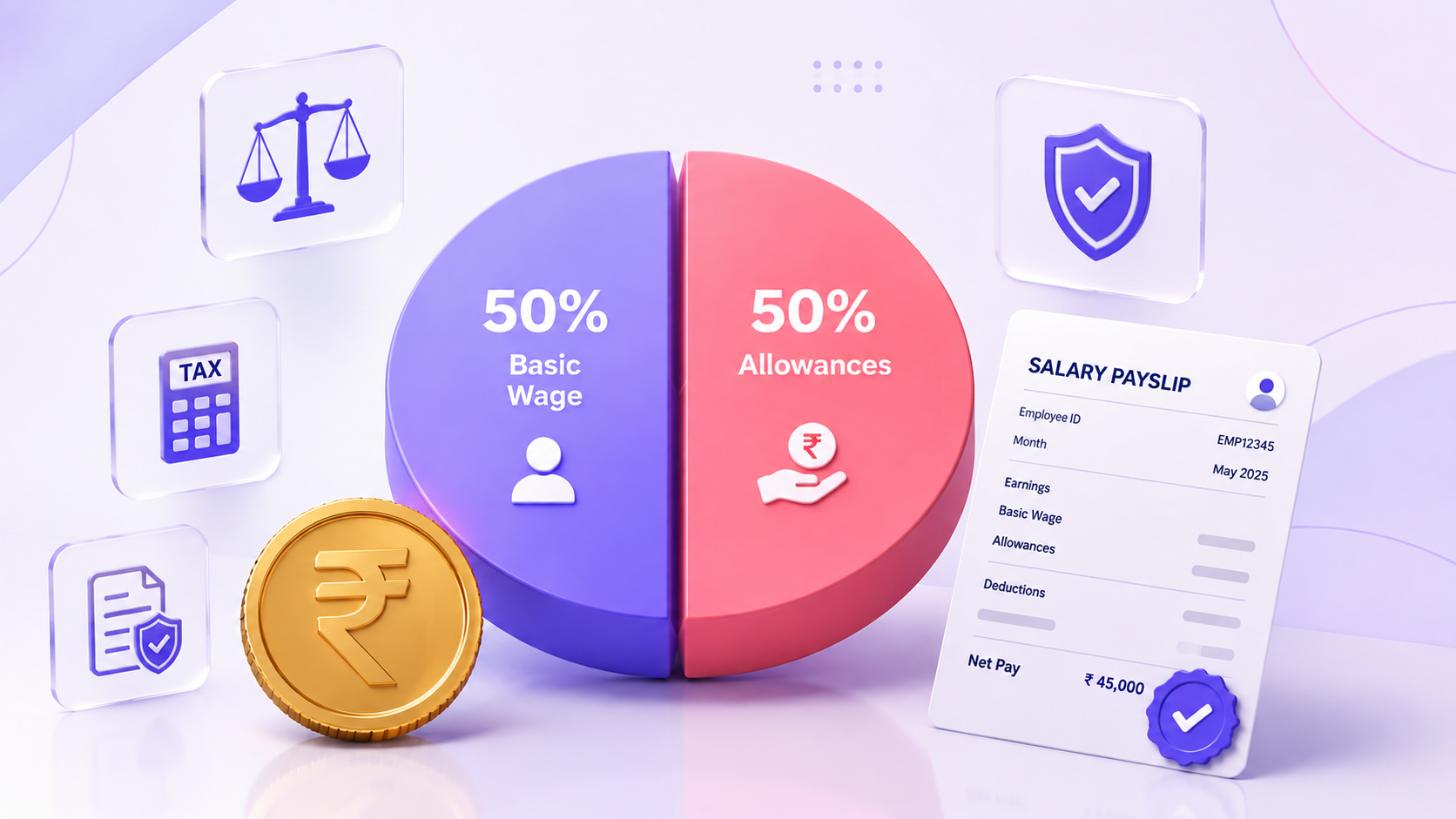
Is your SME ready for the 4 Labour Codes? Learn how the 50% basic wage rule impacts take-home salary, PF liability, and gratuity calculations with real-world examples.
Why Is India Changing Its Labour Laws?
India has consolidated 29 complex, decades-old central labor laws into 4 modern Labour Codes:
1. Code on Wages (2019)
2. Industrial Relations Code (2020)
3. Code on Social Security (2020)
4. Occupational Safety, Health and Working Conditions Code (2020)
The main goal is to standardize wage definitions, protect worker rights, improve social security coverage for gig and contract workers, and make business compliance simpler across states.
The 50% Basic Wage Rule: What Does It Mean?
The most talked-about change under the Code on Wages is the standardized definition of 'Wages'.
Under the new rules:
• Basic Pay + Dearness Allowance must make up at least 50% of the employee's total gross salary (CTC).
• Allowances Cap: All other allowances (like Special Allowance, House Rent Allowance, Travel Allowance) cannot exceed 50% of the total salary package.
• Excess Allowance Conversion: If allowances exceed 50%, the extra amount is automatically treated as basic wage and added to the calculation base for PF and gratuity.
How Does This Impact Take-Home Pay and Retirement Savings?
Historically, many companies kept basic salary low (around 30% to 40% of CTC) and loaded the remaining amount into special allowances to reduce their monthly PF and gratuity liabilities.
With the 50% rule:
• Higher EPF Deductions: Since PF is calculated as 12% of basic pay, a higher basic salary means more money gets deducted for PF each month.
• Lower Monthly In-Hand Cash: Because more money goes into retirement savings, the immediate monthly take-home pay decreases slightly.
• Bigger Retirement & Gratuity Corpus: On the positive side, employees build a significantly larger provident fund balance and receive a substantially higher gratuity payout when leaving the company.
Salary Structure Comparison Example
Component | Traditional Salary Structure | New Labour Code Structure |
|---|---|---|
Gross Monthly Salary | Rs. 50,000 | Rs. 50,000 |
Basic Salary | Rs. 18,000 (36%) | Rs. 25,000 (50%) |
Allowances | Rs. 32,000 (64%) | Rs. 25,000 (50%) |
Employee PF (12%) | Rs. 2,160 | Rs. 3,000 |
Monthly In-Hand Pay | Rs. 47,840 | Rs. 47,000 |
Long-Term Savings (PF+EPS) | Rs. 4,320 / month | Rs. 6,000 / month |
Changes in Gratuity and Leave Encashment
The Labour Codes also introduce practical changes to employment benefits:
• Gratuity for Fixed-Term Employees: Fixed-term contract workers are now eligible for pro-rata gratuity even if they work for only one year, removing the mandatory 5-year requirement that previously applied only to permanent staff.
• Annual Leave Carry-Forward: Rules for accumulating and encashing unavailed leaves have been streamlined to ensure employees receive fair compensation for unused paid leaves.
Conclusion
The new Labour Codes bring positive long-term financial security for employees while requiring businesses to restructure their compensation packages and update employment contracts.
PrimeHR provides built-in salary-structuring templates that automatically comply with the 50% wage rule, ensuring that growing companies transition seamlessly without manual math errors.
Comments
Leave a comment